An Exhibition To Remember
"Dear Hero:" That was the salutation written by schoolchildren Brittany and Kristen in letters to first responders dated September 20, nine days after 9/11, a quarter century ago. The letters, proclaiming, "You have great hearts to love" and "My prayers are always in your hearts," are mounted near a booklet of drawings, "From Children's Hearts, PS 203." One of the drawings features an ambulance and two Emergency Medical Technicians (EMT's), carrying a patient on a stretcher. In the sky above them float two hearts, like giant suns.
"This exhibit was created so that visitors will have a better understanding of the vital role EMS played during the tragic events of that day," said Celia Sporer, PhD, Associate Professor, Criminal Justice, and longtime EMT volunteer.
Dr. Sporer co-curated the exhibit with Jody Resko, PhD, Associate Professor, Social Sciences, whose research and scholarship on Post-Traumatic Stress Disorder (PTSD) have led her to study the effects of ongoing stress exposure on EMS providers. She has collaborated with Dr. Sporer on several research projects and publications including the effects of stress, anxiety, and uncertainty in EMS providers during the COVID-19 pandemic.
"This exhibit gives us a quiet space to process collective memory. It reminds us that behind every moment of crisis is an act of profound human compassion and quiet resilience. Twenty-five years later, these pieces honor not just a moment in history, but the enduring dedication of those who run toward danger instead of stepping back."
A standout feature of the exhibit is a documentary about interviews with EMS providers. The interviews were conducted by Dr. Sporer over the summer.
"These are interviews with friends of mine, EMTs who have never told their stories. All of them were at Ground Zero at one point or another. Among them are Avi Golden who lost several close friends and colleagues.Another friend, Bob Levy, worked at Saint Vincent's at the time, and was one of the first responding ambulances. Ed Pierce was in the fire department, a dispatcher."
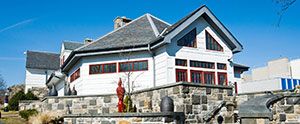
The exhibit opening on September 10 was held on the balcony level of the QCC Art Gallery, an intimate space for a very personal experience. The atmosphere was warm, if somber, mostly quiet save for murmurs of "I was only ten years old when it happened." "I'm scared to hear the video clip." "It's so so sad." "My son was at school at the time." "All the phones were dead." "I saw the medical personnel just waiting."
Among the 9/11 artifacts are a piece of the World Trade Center, paramedic helmets, ambulance keys, a replica of a stone from the walkway of the memorial section dedicated to post 9/11 losses, as well as a series of photographs of damaged first responder vehicles, and video timestamps.
"As a proud New Yorker, this exhibit is very meaningful to me and I'm honored to house these precious 9/11 artifacts in the gallery," said Faustino Quintanilla, Executive Director, QCC Art Gallery. "I thank Celia and Jody for their dedication to the project and believe visitors will gain new insights to the important role of EMS providers on that day."
Like most New Yorkers, Dr. Sporer vividly remembers where she was on that fateful morning.
"I was on my to work near 14th Street and Seventh Avenue. A gorgeous day. And then I saw all the ambulances. As soon as I walked into my office building, we went on lock down. But I wanted to help-the ink on my EMT card was still wet-so I used the freight elevator to leave the building and went to Beth Israel. There was a long line of stretchers. But nobody came, nobody was coming. I also went to John Jay which was supposed to be a receiving site but there was no one there, no one came, nobody was coming, there was nothing to do."
But there is everything to remember.
###