Chapter 2 :The GREEKS
SOCRATES' DEATH and PLATO's THEORY of the FORMS
Arguments for the Existence of the Soul
Now just because someone sits on a desk it doesn’t
mean it is a chair but a chair can’t be just something that you sit on.
You can sit on many things; desks , stairs, large rocks, benches,
tree stumps, cars, your little brother or sister, etc….
What
is a chair?
By
now you should realize that the original simple answer, “Something that
you sit on” , is wrong or at least not really correct.
We can do better than that.
You may now be thinking that a chair is something that was made to
have people sit on it. Further
to prevent a human or other animal from being a chair you should also
realize that whatever a chair is it is non-living matter.
It is inanimate.
In
a classroom someone or other, by now, is offering the following as the
definition of a chair:
A
chair is an inanimate object made for the purpose of having humans sit on
it.
Better
yet:
A
chair is an inanimate object expressly designed and manufactured for the
purpose of having humans sit upon it.
Now
if you agree with that definition being much better than “Something that
you sit on” We are off to a
good start in attempting to understand Plato’s Theory of the forms.
A
chair is an object that humans can sit on, we can also stand on them to
change a light bulb.
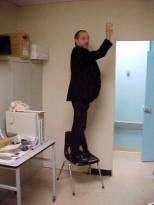
We can use them to hold a door open. We can do a number of things with them but we realize that they are made for one purpose in particular. Chairs do not need to have four legs. They can have three legs , two legs even one leg or no legs at all. Chairs do not need to be blue or brown or green or any color at all. Chairs do not nee to be made of wood or metal . Chairs could be made of clear glass, several large blocks. To understand what a chair is you must abstract from any one particular chair and use your mind to get at the essence of a chair. Its essence is in its purpose. Before the first chair was ever made by a human that human probably got tired of sitting on piles of animal hides or tree stumps or large rocks. That human had the idea of making something to sit on. The idea of the chair preceded its existence. The idea of the chair contains its purpose.
THEORY
of KNOWLEDGE
Plato believed that just as you have realized what a chair is so to can all humans do so by thinking, by using their minds. Plato believed that a human achieves knowledge by recollecting what was known before that human’s soul entered the body. There is a realm of eternal forms, of IDEAS and IDEALS that never change. These IDEAL FORMS exist in a realm apart from this physical universe. They are what make this universe what it is. When humans come to have KNOWLEDGE of something it is actually RECOLLECTING the IDEAL FORM. So Socrates could lead people through questioning to an understanding and knowledge of something without needing to lecture or tell a person what the answer is. Plato demonstrates this in the MENO, in which Socrates leads a person with no knowledge of geometry to correct answers concerning geometric shapes by asking questions. So this universe is what it is to the degree it participates in the realm of the FORMS. The particular things are what they are because the have the FORMS in them or behind their creation and existence. The essence of a thing is what we know and that essence is its FORM. The essence is also its purpose. Knowledge consists of awareness of the essence, the eternal FORM that makes something what it is. The soul existed in the realm of the eternal forms before it entered the human body. It had all knowledge. As it enters the body the soul becomes confused as it experiences particular things that have particular shapes and colors and other attributes that the IDEAL FORM does not have. A person knows what a chair is, its essence, its FORM, before that person is ever born. A person becomes confused after entering the body and seeing particular chairs with their particular forms and hearing people speak a particular human language. Other humans attempt to get that person to identify a sound like “Chair” or a series of letters like ”c-h-a-i-r “ with a particular object, such as a brown, wooden, four legged, chair with a straight back. The child makes the identification and the mind of the child is led away from the knowledge of the pure essence of what a chair is. The child knows the essence of mother and father and table and tree and all things before it is born but gets confused by people uttering sounds like ”mommie” and “mamma”, “say “ mommie , baby” “say mommy”.
Plato was the first to put into writing a theory of how it is we have knowledge and to explain how we make mistakes. For Plato knowledge is recollecting (Anamnesis) , remembering what we were in contact with (knew) before our souls (minds) entered our bodies. Plato accepted an idea that many Greeks believed: reincarnation. So he believed that we live in some form before we enter the body and that we survive after leaving the body and might enter another body to experience another lifetime. He developed this theory of the FORMS and used it to explain KNOWLEDGE. In the PHAEDO, he will make reference to these ideas in order to prove the existence and survival of the soul without the body.
Plato's
theory:
Particular thing -> essence -> function, purpose ->FORM -> ETERNAL FORM
Things are what they are because of their forms. We know the form and not the thing itself. We know the group or category a thing fits into, participates in, is made real by and not the concrete particular thing. What we know about a thing such as:
![[picture of chair]](Socrat8.jpg) [picture
of chair]
[picture
of chair]
Is that it is a chair. That it is a member of a group or set or category of things called ”chair” because it has the same essence, purpose or FORM.
“Chair” is also a member of another set or FORM called “furniture” again because it shares in the same essence as other members of that set such as; “table” and “lamp”.
Plato believed that all people can reason and it is reason that can cause a person to have knowledge, to move away from focusing on the particular concrete object and to recollect the universal abstract essence or FORM of the thing. That knowledge was necessary for understanding and for wisdom. The senses are a distraction for humans and often confuse humans. For genuine understanding a human needs to get beyond the senses to reach the truth through reasoning. Reasoning would have us deal with ideas and not the particular phenomenal aspects of the object. If we keep looking at the four legs of a chair we will not come to understand truly what a chair is.
Plato believed that just as all people can come to understand and agree that:
2+ 3 = 5,
then all people can come to understand that
a chair is an inanimate object designed and manufactured for the purpose of having humans sit on it.
He believed that with proper concentration and reasoning all people would also come to understand the essence of :
TRUTH, BEAUTY, GOODNESS, TEMPERANCE, COURAGE, JUSTICE, LOVE, FRIENDSHIP
and all the Virtues and all the important matters for humans to know.
He
thought this because he thought that all those words referred to IDEAL
FORMS that are in all of us and need only the proper thinking, led by
questioning and guided by dialectical reasoning.
Plato’s contribution to the world of thought was this Theory of the Ideal Forms. They would explain how things come to be as they are, the order of the universe, how we come to know things, how we make mistakes, how we should live our lives. It is the FORM and not the particular thing that is important, VIRTUE and not the particular life that is important. To be in a human body and thus to be ensnared by its distractions and temptations was an embarrassment to Socrates and to Plato. Humans need to get out of their bodies (to die a bit) through reflection and reasoning to get at the truth and understanding. The body misleads us, the senses confuse us, our perceptions are not to be trusted.
THINGS
ARE NOT WHAT THEY APPEAR TO BE!
I
can swear to you that for me still, the sun looks to me as if it is not
that hot, not that big and not that far away. And I swear it moves! However,
I have “learned” that the truth is quite the opposite. But I swear that the earth does not look or feel as if it is
moving! It does not look
round. To me the earth looks
flat and stationary. But I am
informed that it is actually spherical and rotating as it moves around the
sun. It rotates at over 17,000 miles an hour! Imagine that! Well I can’t imagine it. I
can not see it. I have no feeling for it. And yet it is true?
If you are inclined to dismiss Plato’s theory, consider this: much of what you know and believe and much of modern science owes a great deal to Plato’s theory. The laws of Nature are discernable to those who can detach from the particular observations and look for patterns, look for FORMS in the data. It was Plato who commended us to measure things and to look for what only reason could see operating in the universe in order to discover (remember) the truth and gain knowledge! (see the TIMAEUS)
I will therefore
now proceed to speak of the higher use and purpose for which God has given
eyes to us. The sight in my opinion is the source of the greatest benefit
to us, for had we never seen the stars, and the sun, and the heaven, none
of the words which we have spoken about the universe would ever have been
uttered. But now the sight of day and night, and the months and the
revolutions of the years, have created number, and have given us a
conception of time, and the power of enquiring about the nature of the
universe; and from this source we have derived philosophy, than which no
greater good ever was or will be given by the gods to mortal man. This is
the greatest boon of sight: and of the lesser benefits why should I speak?
even the ordinary man if he were deprived of them would bewail his loss,
but in vain. Thus much let me say however: God invented and gave us sight
to the end that we might behold the courses of intelligence in the heaven,
and apply them to the courses of our own intelligence which are akin to
them, the unperturbed to the perturbed; and that we, learning them and
partaking of the natural truth of reason, might imitate the absolutely
unerring courses of God and regulate our own vagaries. The same may be
affirmed of speech and hearing: they have been given by the gods to the
same end and for a like reason. For this is the principal end of speech,
whereto it most contributes. Moreover, so much of music as is adapted to
the sound of the voice and to the sense of hearing is granted to us for
the sake of harmony; and harmony, which has motions akin to the
revolutions of our souls, is not regarded by the intelligent votary of the
Muses as given by them with a view to irrational pleasure, which is deemed
to be the purpose of it in our day, but as meant to correct any discord
which may have arisen in the courses of the soul, and to be our ally in
bringing her into harmony and agreement with herself; and rhythm too was
given by them for the same reason, on account of the irregular and
graceless ways which prevail among mankind generally, and to help us
against them.
Thus far in what we have been saying, with small exception, the works of
intelligence have been set forth; and now we must place by the side of
them in our discourse the things which come into being through
necessity-for the creation is mixed, being made up of necessity and mind.
Mind, the ruling power, persuaded necessity to bring the greater part of
created things to perfection, and thus and after this manner in the
beginning, when the influence of reason got the better of necessity, the
universe was created. But if a person will truly tell of the way in which
the work was accomplished, he must include the other influence of the
variable cause as well. Wherefore, we must return again and find another
suitable beginning, as about the former matters, so also about these. To
which end we must consider the nature of fire, and water, and air, and
earth, such as they were prior to the creation of the heaven, and what was
happening to them in this previous state; for no one has as yet explained
the manner of their generation, but we speak of fire and the rest of them,
whatever they mean, as though men knew their natures, and we maintain them
to be the first principles and letters or elements of the whole, when they
cannot reasonably be compared by a man of any sense even to syllables or
first compounds. …..
This new beginning of our discussion of the universe requires a fuller
division than the former; for then we made two classes, now a third must
be revealed. The two sufficed for the former discussion: one, which we
assumed, was a pattern intelligible and always the same; and the second
was only the imitation of the pattern, generated and visible.
READ on the Theory of the Forms
Now we can proceed to a presentation of the actual dialogue, the Phaedo
On the Phaedo in wikipedia:
The
Death of Socrates
READ: Phaedo Written 360 B.C.E Translated by Benjamin Jowett
READ along Phaedo at this youtube site : 3:03:58
Here is a presentation of the Phaedo in English with a listing of topics for reference purposes:
Video Lecture on Phaedo by Shelly Kagan, Clark Professor of Philosophy, Yale University, 46 minutes
At the time of the events in the dialogue, Plato was ill and did not observe the final hours of Socrates life. Several friends of Socrates find him just awakening on the day when they know his execution must take place. Socrates appears in rather good spirits. This surprises his friends. They have removed his shackles and he is appreciative of how good it feels to have them off. Socrates (Plato) speculates that things appear to come in opposing pairs , if it wasn’t for the pain we wouldn’t appreciate the pleasure of the absence of pain. Plato may be indicating here that if God creates anything god must create its opposite as well. Hence if god creates the good , god is also responsible for evil.
His friends inquire as to how he appears cheerfully willing to die. Socrates indicates that those who tackle Philosophy ought to be cheerfully willing to die for they have been practicing death. If death is the separation of the soul from the body and if philosophers who pursue after wisdom must focus their minds away from the body and remove their minds(Souls) from the affairs of the body, then practicing Philosophy is like practicing dying. Philosophers can only get to truth by reasoning which will arrive at the essence of things. One can examine real things by the mind (soul) alone. To pursue wisdom is to set the soul free of the body to arrive at true knowledge. The soul with wisdom and virtue is purified and will dwell with the gods.
His friends ask how he can be so certain that the soul will continue to survive after the death of the body. Socrates indicates that given his position he has the right to speculate on this question.
He offers four arguments:
A short analysis of Socrates’ first argument for the immortality of the soul in the Phaedo.
by Gregory Weston
In the Phaedo, Socrates begins his first argument for the immortality of the soul by asking Cebes, who wonders about the immortality of the soul, if it is true that a thing can only change by becoming its own opposite, that is to say, something large can only come from something was smaller before, and vice versa. Then he continues asking if it is so that the weaker comes from the stronger, the swifter from the slower, the worse from the better, the just from the unjust, and Cebes, of course, agrees. From here Socrates establishes that all things come to be this way, opposites from opposites (70e-71c). Socrates then gives one more example, that of sleep coming from wake and wake coming from sleep, before applying this principle to life and death, which he thinks then proves that souls are reincarnated, which necessarily proves that they are immortal. Here is his transitionary argument:
It is agreed that the living come form the dead in this way no less than the dead from the living and, if that is so, it seems to be a sufficient proof that the souls of the dead must be somewhere whence they can come back again. (72a)
A problem with this argument is that Socrates distinguishes between dead things and things that were never alive. Simply saying “the living come form the dead,” I think no one would find controversial, but this doesn’t prove reincarnation if you say the living come from dead rocks and dead water -- it only does if you say the living comes from dead men. But I can think of no reason, empirical or otherwise, to distinguish between a dead man and a never lived rock. So the argument fails.
There is another, much larger gap in Socrates’ argument. When Socrates establishes that incarnate beings expire, and that life must come from dead things, he then assumes, without any proof, that souls exist, retain their form after death, and, disembodied, go underground during for a while before returning to the world in another body. But do men have souls? Perhaps they do, but there is no proof to this religious doctrine, and as long as one can bring in arguments based on supernatural premises into a philosophical inquiry whenever one fancies, there is little point in it all. If one is willing to posit the existence of souls, why not just posit immortal souls, and save the bother of an even larger number of arguments?
1. First argument for the existence of
the Soul
Socrates has his audience acknowledge that the dead come from the living and so he reasons that if things come in opposites then the the living come from the dead. So, the soul existed before it came into the body and will exist when it leaves again.
2. The second argument: Souls pre-exist the body Argument using Theory of Knowledge as Recollection
If the dead come from the living and the living come from the dead, how can we be sure that souls exist before they enter the body?
Socrates reminds his friends about the theory of knowledge. We know what a “hair” is and we know what “equality “ is through an act of recollection in which our soul remembers what it knew before it came into the body. So because of the theory of knowledge as remembering (anamnesis) we are assured that the soul exists prior to entering the body.
3. The third argument: sometimes called the Affinity Argument
Does the soul really exist AFTER death? Socrates responds that all they need do is combine the first two arguments. Further, What exists forever is always the same and is uncompounded. It is spiritual, immaterial and immortal. The soul is invisible, unchanging and divine; unlike the body which is visible, changing and mortal. The soul is thus spiritual and like the divine and so humans have a duty to keep it pure and thus it shall be immortal. To keep the soul pure is what the wise should do and it will provide happiness as well. Souls need to be properly separated from the body so as to insure their continued existence otherwise it becomes like unto a ghost that will want to return to the flesh. The properly detached soul in virtue will live free of the body in the heavens..
4. The fourth Argument: Using the theory of the
forms
Simmias and Cebes challenge Socrates. Simmias wonders that the soul might be to the body as harmony is to a stringed instrument. When the instrument is destroyed there can be no harmony anymore. In this view the soul is the attunement of the body. It is not visible but it is not immortal either.
Cebes thinks that the soul might be as a garment that someone can wear until they die and then the son wears the garment until he dies and then his son after him until the garment finally wears out. The soul may last longer than the body and enter several bodies through time, but it may not be immortal.
Before taking on these challenges directly, Plato has Socrates issue a warning about how to proceed with philosophical inquiry and what to avoid. Simmias and Cebes should not be as the Sophists and be raising challenges for the sake of arguing and debating. They should not be haters of arguments. They should be looking for truth and wisdom. They should be reasoning and not quarreling. Socrates thinks that if they had thought a little more there would have been no need to raise the issues that they did raise.
The jailer speaks to Crito asking him to calm Socrates down. The jailer has prepared a poison (hemlock) for Socrates to take. The jailer is concerned that if Socrates is in an agitated state when he takes that poison it might not work. It may take more poison to kill Socrates quickly. When Socrates learned of this he informs Crito to tell the jailer to prepare a triple dose because Socrates was not about to calm down in the last hour of his life, not if he did not want to. He was engaged in a dialectical dialogue and this is what he was about throughout his life. He was looking for wisdom concerning death and he was close to it and did not want to stop.
Socrates responds to the objections of Simmias who wanted to compare the soul to harmony. The theory that the soul is like a harmony is proven fallacious by the theory of recollection as the harmony does not precede its elements, nor does it have knowledge, nor is it a ruling principle, and a harmony admits of degrees of concord and dissonance, but the soul has no degrees as to its being.
As to the objections of Cebes , Socrates has another set of remarks. Cebes thinks of the soul as a longer lasting but physical thing that eventually wears out. Socrates responds by pointing out that those who examine the truth and want knowledge of what is real must take refuge in reasoning. Socrates was not like Anaxagoras in believing that all things that exist are physical. When Socrates was younger he was attracted to the theory of Anaxagoras that all could be explained as the result of MIND and MATTER.
Anaxagoras was the thinker who taught that the universe was made up of Mind and Matter. Mind or NOUS set it all in motion in the beginning and has very little to do with it afterwards. The sun was a ball of fire and not a god and the moon was a rock reflecting light and not a goddess. Athens invited him to town and set him up so that he would teach others about his ideas. He had considerable reputation. The Athenians enjoyed and valued the life of the mind. After it became apparent that Anaxagoras was not supportive of Athenian traditions he was charged with being an atheist, harmful to Athens and he escaped before he could be punished (executed).
Socrates entered his school to learn about the theory but learned that for Anaxagoras the NOUS set all in motion in the beginning of the universe and then had nothing to do with events afterward. Socrates thought that if all there was to life was the experiences of the body he would have left the prison and gone off to live a little longer somewhere. However, he remained in prison due to the activities of his MIND. Socrates will use that mind and reasoning in order to answer Cebes. Socrates explains how the absolute essences cannot admit their opposite, and since the soul is the essence of life, there is no way it could become death. Therefore, the soul is immortal. It is generally recognized that God and the essential form of life and the immortal will never perish. Thus when death attacks a man, the body may die, but the immortal soul retires at the approach of death and is preserved safe and sound, and truly exists in another world.
Fourth Argument for the Existence of
the Soul
When the arguments are completed, Plato has Socrates issue a warning and advice. He informs us that when reasoning and developing arguments we should scrutinize the first suppositions upon which all thought rests. Thinkers should examine the foundations of all arguments. Philosophers do not often make mistakes in reasoning. They are ore often than not found wanting for not providing a better defense of the starting points or initial supposition for their thinking and arguments.
Although Socrates and Plato both criticized artists for presenting false portrayals of reality and although both were critical of the myths of their time, Plato now present a myth which describes the afterlife and how the soul will be judged and will be rewarded or punished in the next life.
At the conclusion of the story (myth or moral) Socrates
states:
"So for such things to be relied upon as being thus, as I described,
it is not fitting for a man having intelligence; yet that it is this or
some such thing concerning our souls and the homes, since the soul appears
to be immortal, this also seems to me fitting and a venture worthy of
imagining it is so; for the venture is beautiful; and such things are
useful in singing to oneself, wherefore I also have lengthened the past
story.
"However on account of these things it is useful for a man to take
courage concerning his soul, who in life renounced the other pleasures of
the body and its ornaments, as being alien, believing even more it is
another thing to be perfected, and has been serious about learning things
and has adorned the soul not with something alien but with her own order,
discretion and justice and courage and freedom and truth, thus one waits
for the journey into Hades, as passing when destiny should call."
Socrates is warning us not to take the tale seriously
because it can not be true, literally.
But it is better for people to believe that something will happen
to our souls after death. It
is better because while alive people will take care of their souls, pursue
a good life, because they are fearful of what might happen after death. Thus, it is better to believe than not to believe.
This is so because of the REASONS that Plato gives.
Plato believes that the myth he reports is worthy of belief because
it would make us better: live better in this life and earn us a better
life in the after world.
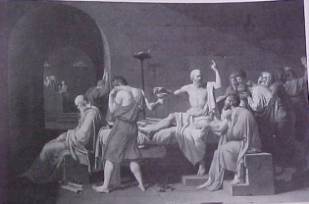
Death
of Socrates by Jean Louis David
from the PHAEDO:
Socrates went and bathed himself to save the women
the trouble of doing so after his death.
He kissed his wife and children.
He took the cup of poison and drank it.
He walked about and after a few seconds he felt his legs getting
numb. He sat down, then lay
down. He grew weaker quickly.
The text:
When the poison reaches the heart, that will be
the end. He was beginning to grow cold about the groin, when he uncovered
his face, for he had covered himself up, and said (they were his last
words)-he said:
Crito, I owe a cock to Asclepius; will you remember to pay the debt?
The debt shall be paid, said Crito; is
there anything else? There was no answer to this question; but in a minute
or two a movement was heard, and the attendants uncovered him; his eyes
were set, and Crito closed his eyes and mouth.
Such
was the end, Echecrates, of our friend, whom I may truly call the most
wise and most just and the best of all the men whom I have ever known.
-------Plato
Many people seem quite interested in learning of the last words of people. Socrates last words were:
I owe a cock
to Asclepius; will you remember to pay the debt?
What might this mean? Asclepius was the god of medicine. People would go to a temple of that god when they were ill to ask for healing. They would make an offering of coins or animals in order to obtain the god’s favor, instructions on getting well or a potion to take. They would do this for themselves ro for a friend. When they recovered they would go to the temple to make a payment as a thanksgiving offering.
Now , Socrates could mean that the god Asclepius had sent him a potion (the poison hemlock) that would now free him from his mortal coil, free him from entrapment in his body and allow his soul to go to its reward, to a state where he would have knowledge, truth and all GOOD things. That is one possible meaning. The poison for others was like a healing charm for Socrates.
Another possibility is this. Plato writes the dialogue. Plato was not there, he was ill. Plato heard what Socrates had said. Perhaps, Socrates was thinking of Plato. Perhaps, Socrates had prayed to the god of medicine, Asclepius, to heal Plato to cure him of his attachment to the things of this world and make him better, healthier, whole. Plato was so upset over the death of Socrates that he left Athens in disgust. He underwent a “conversion” of a sort and moved away from a career as a poet and statesman and became a Philosopher!
Part of Socrates Legacy is Plato himself. More of his legacy in the next section.
Suggested Reading:
Kemerling, Garth. on PHAEDO and "Plato: Immortality and the Forms"

Proceed to the next section

Introduction to Philosophy by Philip A. Pecorino is licensed under a Creative Commons Attribution-NonCommercial-NoDerivs 3.0 Unported License.